Lead capture from where leads actually come
Meta lead forms, website enquiry forms, landing pages, WhatsApp inbound, walk-ins at the site office and broker referrals — each tagged with its true source so spend can be judged later.
Developer CRM
Most CRM sold to real estate is built for agents: capture a lead from a portal, chase it, close a commission. A developer's problem is different. You own the inventory, the price rules, a four-year payment schedule and a construction timeline — and your CRM has to sit on top of all of it. That is what this one does.
An agent CRM optimises one thing: moving a lead to a transaction someone else owns. It integrates with listing portals, scores leads, and reports on conversion. Every one of those features assumes the inventory belongs to a third party.
A developer's CRM has to answer questions an agent never asks. Which unsold units match this buyer's budget and facing preference, today? What did we quote this buyer six weeks ago, and was that rate approved? If they book, what does their kisti schedule look like against the construction milestone plan? Is the broker who introduced them entitled to a commission, at what slab, and when does it release?
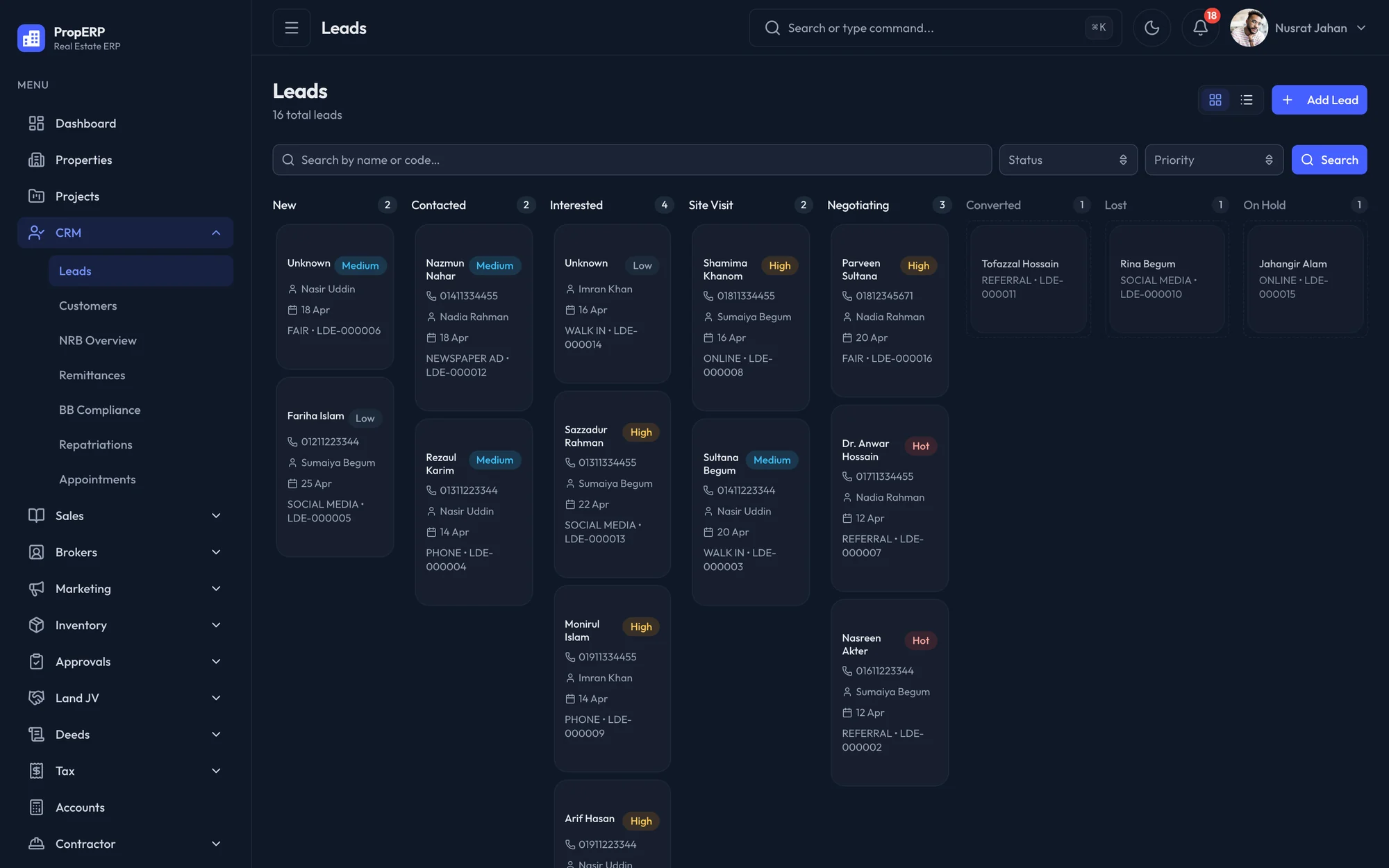
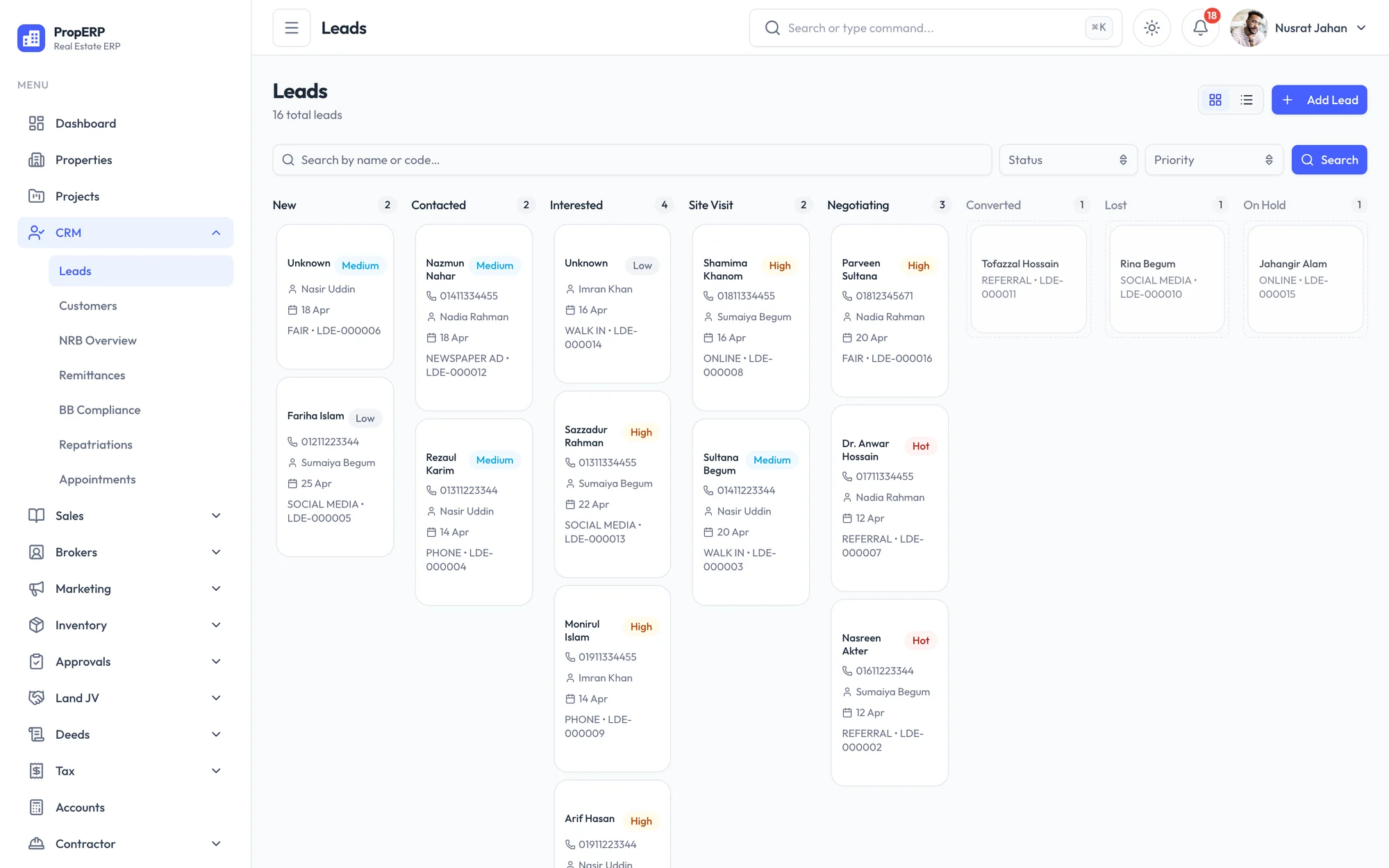
PropERP's CRM is the front end of the same system that holds units, prices, schedules and receipts. A lead is not a card on a board — it is a record attached to real inventory, and moving it forward changes the inventory.
The lead source, every message, the site visit, the quotation with its approved rate, the booking and the receipt — in order, on one record, with the buyer context that decides how this deal is actually handled.
CRM / Lead 4417 — Rezaul Karim
12 Jun
Lead captured — Facebook lead form
13 Jun
WhatsApp template sent · delivered, read
18 Jun
Site visit booked — Green Valley, 4:30 PM
21 Jun
Quotation issued — A-4A @ ৳ 9,200/sft
29 Jun
Booked — money receipt MR-2026-00418
Booked · 5 of 5 stages
100%17 days lead → booking
| What you need | Agent CRM | PropERP developer CRM |
|---|---|---|
| Inventory | External listings, refreshed manually. | Your own units, live status, locked when booked. |
| Pricing | Whatever the agent types. | Rate rules, premiums and approved discounts. |
| After the sale | Deal closed, record goes quiet. | Kisti schedule, receipts and handover continue on the same record. |
| Broker payment | Commission is the agent's own income. | Channel partner slabs resolved against the booking and collections. |
| Buyer context | Name, phone, budget. | NRB status, co-buyer, nominee, language, family decision-maker. |
| Reporting | Leads and conversion rate. | Booked value, collection against schedule, unsold inventory ageing. |
Meta lead forms, website enquiry forms, landing pages, WhatsApp inbound, walk-ins at the site office and broker referrals — each tagged with its true source so spend can be judged later.
Filter live availability by budget, size, facing, floor and project. The salesperson offers what exists rather than what they remember.
Visits booked against a project and a person, with reminders to the buyer and the sales executive, and the outcome recorded on the lead.
Generated from rate rules, versioned, and requiring approval when below floor price — so a quote is a controlled document rather than a WhatsApp message.
The person paying is often not the person visiting. Co-buyers, decision-makers abroad, preferred language and remittance channel are on the record, not in a salesperson's head.
Stages are tied to real events — visit done, quotation issued, booking money received — so the forecast is derived from actions rather than optimism.
Automation should remove typing, not accountability. Every rule below runs inside the same permissions, templates and project scoping your leadership already approved, and every action it takes is written to the lead timeline.
Assign by project, source, language, territory or round-robin within a team. A lead from a Friday-night Facebook ad has an owner before Saturday morning.
Stage age, last contact and channel history produce a suggested next step for the owner, so a rep opening the app knows which twelve calls matter today.
A stage change, an SLA breach or a campaign tag can start a sequence. The sequence only sends through approved templates where the channel requires them.
Unworked leads escalate to a manager queue on a defined clock. Nothing is silently reassigned — the timeline records who held it, for how long, and why it moved.
Those are excellent general or agent-side tools, and they can hold leads well. What they do not hold is your unit inventory, your rate rules, your payment schedules and your receipts — so the moment a lead becomes a booking, the record has to be re-entered somewhere else. Here it does not.
Yes. Meta lead forms and website forms post directly into the CRM with their source intact, and duplicates against existing phone numbers are flagged rather than silently created.
Yes. Overseas address and time zone, preferred language, remittance channel, a local nominee and a co-buyer are all part of the buyer record, which matters because the person visiting the site office is frequently a relative rather than the buyer.
Yes, with role-based access. A project sales team sees its own pipeline; management sees consolidated booked value, conversion by source, and unsold inventory ageing across every project.
No — the CRM can be switched on first. But it is worth understanding that the reason it works differently from an agent CRM is precisely that it can read the inventory, pricing and collection modules underneath it.
Next step
Bring a week of leads and one project's unsold list. The useful part of the demo is watching a lead get matched to units that actually exist.
What the demo covers