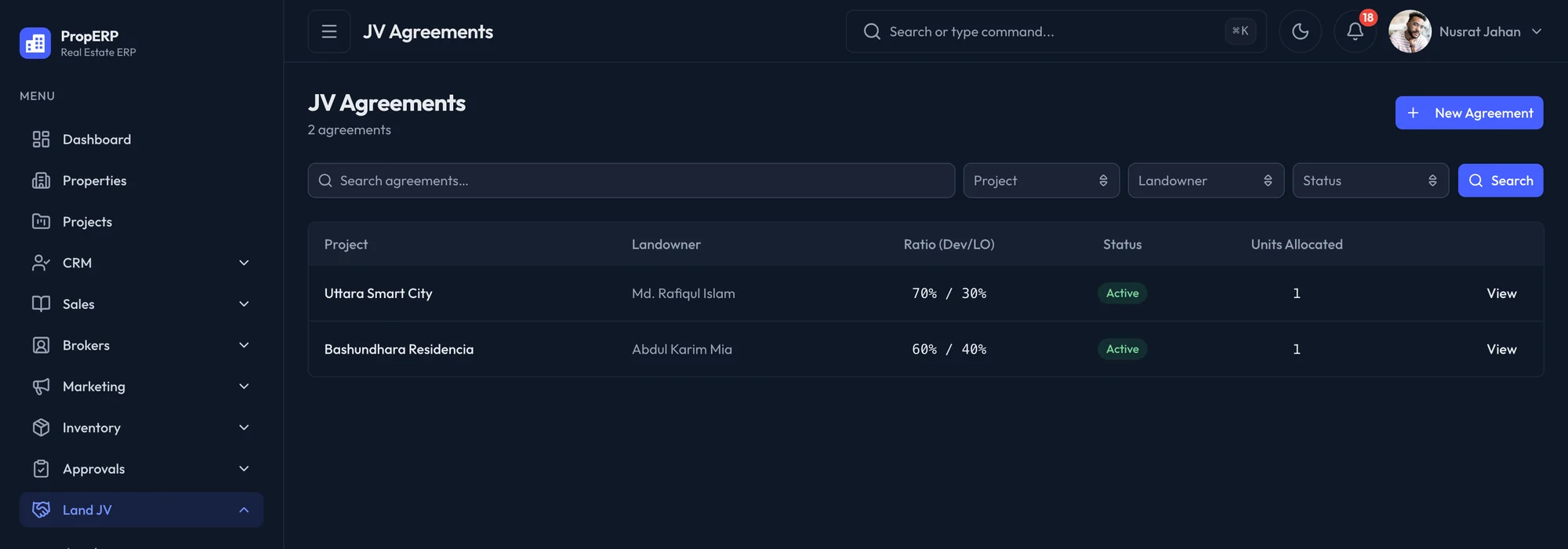
The agreement, structured
Ratio, signing money, adjustment cash, floor preference, parking split, escalation clauses and the completion timeline — as fields, so they can drive calculations instead of being read from a PDF.
Joint venture
Joint venture land agreements are the default way apartments get built in Dhaka, and the least automated part of the business. PropERP holds the agreed ratio, the exact units on each side, signing money and its adjustment, and the handover position per unit — so the landowner conversation runs on a shared record instead of two competing spreadsheets.
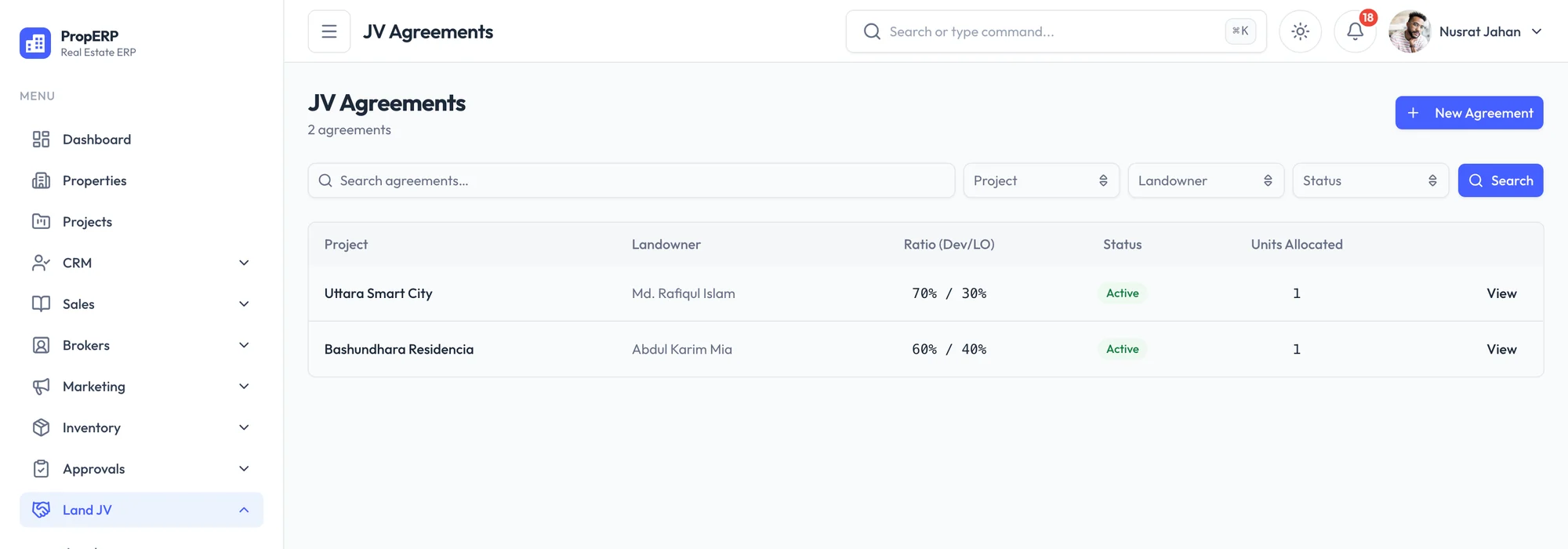
A joint venture agreement is simple on paper: the landowner contributes land, the developer contributes construction and capital, and the built units are divided in an agreed ratio. Everything after that sentence is where the disputes come from.
Ratios are rarely clean. A 42:58 split across 38 units does not divide into whole flats, so the agreement adds adjustment cash, a preferred-floor clause, parking allocation and sometimes a specific named unit. Signing money is advanced against the landowner's future share and has to be recovered. Some landowner units are sold back to the developer mid-project. Others are sold directly by the landowner to a buyer who then appears in your sales office expecting service.
None of that survives in a spreadsheet across a four-year build. PropERP puts the agreement itself in the system: the ratio, the named allocation, the money moving in both directions, and the obligation list on each side with dates.
The agreed ratio, the unit-by-unit allocation, and where each side stands on deed execution and handover — with landowner units automatically locked out of sales inventory.
Joint venture / JV agreement — Uttara Sector 12
13 of 22 units
59%| Unit | Allocated to | Size | Position |
|---|---|---|---|
| A-3A | Landowner — Md. Alauddin | 1,450 sft | Handed over |
| A-3B | Developer | 1,450 sft | Sold |
| A-4A | Developer | 1,450 sft | Booked |
| A-4B | Landowner — Rokeya Begum | 1,450 sft | Pending deed |
| A-5A | Developer | 1,620 sft | Available |
Landowner units are locked out of the sales inventory automatically — nobody can book them by mistake.
Ratio, signing money, adjustment cash, floor preference, parking split, escalation clauses and the completion timeline — as fields, so they can drive calculations instead of being read from a PDF.
Every unit is assigned to the landowner side or the developer side by name, with the reason. Allocation changes are versioned so a later dispute has an audit trail.
Most parcels have co-owners with unequal shares. Each landowner's individual entitlement, payments received and units allocated are tracked separately within the same agreement.
Signing money advanced, rent or accommodation allowance paid during construction, and adjustment cash owed at handover — netted against the landowner's position rather than tracked as loose payments.
Landowner-allocated units cannot be booked by the sales team. When a landowner sells their own unit, the buyer is recorded without the unit ever entering developer revenue.
Deed execution, possession letters, utility connections and snag closure per unit, with dates, so the completion conversation is evidence rather than memory.
38 units on a 18.5-katha parcel with three co-owners — the arithmetic that causes most JV arguments.
| Item | Landowner side | Developer side |
|---|---|---|
| Agreed ratio | 42% | 58% |
| Entitlement in units | 15.96 | 22.04 |
| Units allocated | 16 | 22 |
| Adjustment cash | Payable to developer | Receivable ৳ 5.9 L |
| Signing money | ৳ 1.80 Cr advanced | Recovered against allocation |
| Parking slots | 16 of 40 | 24 of 40 |
The 0.04-unit remainder is settled in cash at the agreed per-square-foot rate. Every JV has a line like this, and it is the line most often lost between versions of a spreadsheet.
Yes. The system computes the fractional entitlement, records the whole units allocated, and holds the residual as an adjustment amount at the agreed rate, payable in either direction at handover.
Each co-owner is tracked individually inside the agreement, with their own percentage, allocated units, signing money position and document status — so a settlement with one landowner does not have to wait on the others.
No. Allocated landowner units are excluded from sellable inventory automatically. If a landowner later sells a unit privately, the buyer is recorded against that unit without it counting as developer revenue.
Yes. Signing money and any construction-period allowance are held as advances against the landowner's position and netted at the settlement point, so the recovery is never an off-system calculation.
The parcel record, its khatian and deed chain sit in the land module; the commercial agreement over that parcel sits here. Both hang off the same project, so acquisition history and JV obligations read together.
Next step
Bring an agreement that is mid-construction — ideally one with more than one landowner. We will model the ratio, the allocation and the adjustment on the call.
What the demo covers